
This is Why We Invented It
Why We Invented
Building Communities
New Solutions to Old Problems
For generations, economics has been referred to as the “dismal science.” Communities try to focus on the future but it does not seem to make a difference. Effort goes unrewarded. In the meantime, nothing changes.
It does not have to be this way.
The table below shows how Building Communities has developed tools and a planning process that leads to…
Overcoming the 8 Biggest Problems
Big Problem
Building Communities Tools and Processes
#1:
Vision Statements
and
Mission Statements
are often generic
and worthless.
Community Elevator Speech
Stephen Covey recommends “beginning with the end in mind.”
We add that you should “end with the beginning in mind.”
We do not begin by gathering 20 or so people around a conference room table with flipcharts and spend hours only to generate a paragraph or two.
Rather, we end our process by asking very specific and penetrating questions to the people who care most about their community. By the end of the process,  everyone has fully considered the challenges and possibilities for their community.
Why do you care about your community?
What is unique?
What strategies/initiatives/projects are you most excited about implementing?
The result becomes “Page One” of your plan.
This captivating, concluding conversation becomes the stage-setting content that not only engages the plan’s reader, but also sets the community in motion.
#2:
Loud voices
frequently
smother
thoughtful ones.
Electronic Clickers
In a group discussion, extroverts almost always dominate introverts.
Dominant people usually drown out thoughtful ones.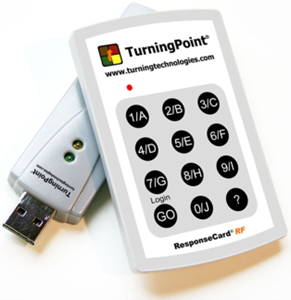
Yet everyone who desires to participate in the strategic planning process wants their voice to be heard.
Building Communities utilizes electronic response cards
(or “clickers”) to give everyone equal input into the process.
The result of the inputs are instantly projected on a screen so that everyone
has immediate and valuable content on which to base decisions.
#3:
Capacity is
important…
…but very few
people know what
capacity is.
Community Organizer Assessment
Simply stated, capacity is the ability to get things done. In the context of community and economic development, this requires human, financial and technical resources.
Communities have significant ability to invest in—and increase—community and economic development capacity.
But how do you objectively measure this capacity?
Building Communities invented the Community Organizer Assessment which asks a series of questions, each designed to measure and prescribe needed capacity.
Because we have incorporated capacity questions into our DASH™ software, the “next question” always depends on previous questions asked.
The result: a tailored set of questions and
“multiple choice” responses unique to every community.
Building Communities takes the guesswork out of addressing capacity issues. Rather than just having a subjective conversation, communities immediately understand their capacity level, and what they can do to increase it.
#4:
Community
leaders are
unaware of all of
their options.
Strategy Wheel
All too often, communities only focus on the classic “Big-Two” community and economic development strategies: Business Recruitment and 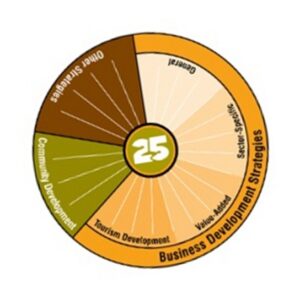 Business Retention and Expansion.
Some communities may consider Entrepreneurial Development.
Most communities stop there.
With the experience gained through facilitating the development of more than 60 community strategic plans, Building Communities has concluded that there is a menu of 25 viable strategies to consider. They are all presented on the strategy wheel. All strategies are reviewed and considered by all communities.
Many communities may come into the process with a pre-conceived set of strategies they want to focus upon. That is okay. The time it takes to consider the remainder of the menu is presented very efficiently.
And, who knows? Selecting and implementing new strategies and initiatives may be exactly what your community needs.
#5:
People do what
they want to do…
…not necessarily
what they should
do.
Key Success Factor Analysis
All too often, communities behave like individuals. They only do what they want to do.
Being strategic, however, means selecting strategies with the greatest chances for successful implementation.
For example, there are 17 Key Success Factors to successfully implement a Business Recruitment strategy. Without comparative advantages for many of the factors, successful implementation of this strategy is difficult, if not impossible.
In the first two hours of Plan Week, planning participants consider their community’s comparative advantage on all 88 factors relevant to successful community and economic development.
Considering Key Success Factors should not necessarily eliminate strategies from consideration—this important planning step simply identifies the “challenges which must be overcome,” if such strategies are selected.
#6:
People do not like
the proverbial
report sitting on
the shelf…
…but reports still
sit on the shelf.
Essential Action Steps Planner
 No one embarks upon a strategic planning process simply to build the plan. Everyone wants to experience the benefits they anticipate from implementing the plan.
Yet invariably, plans sit on the shelf. The four months that elapse immediately after the plan is adopted becomes the Bermuda Triangle of economic development.
Building Communities solves this problem with its Essential Action Steps Planner.
The Planner is an on-line tool where planning participants chronicle their action steps, implement them, monitor them and report the results to the community, governing bodies, funders and other interested parties.
The Planner engages the planning participants to identify and chronicle their action steps—who is going to do what by when.
But this is not a document that can sit on the shelf. There is no shelf.
It is impossible for a Building Communities-based plan to sit on the shelf.
Welcome to effective strategic planning in the 21st century!
#7:
Public input
and plan content
are often two
different things.
Voice of the Community Meeting
 From the onset, generic strategic planning is set up to fail. An out-of-town consultant, typically with little or no background on the dynamics and possibilities of a community, shows up and asks the generic question:
“What do you want?”
The feedback is then seasoned with the experience of the consultant, yielding a plan that may seem foreign to many of the planning participants.
The result: a vast gap between public input and plan content.
Building Communities has designed the public participation element of the process, the Voice of the Community Meeting, to integrate public input with plan output.
Planning participants are asked three questions. The first two questions relate to their thoughts about the desirability and feasibility of the 25 strategies. The third question allows for a more free-flowing conversation about “what is impacting the quality of life in your community?”
Not only do planning participants have the expertise to contribute to the content of the plan, but their voices are always heard by the local Steering Committee members who use the input to select and refine strategies.
#8:
Some communities
are simply
not conditioned
for success.
Civic Condition Assessment
This is the hard part. Anyone who has ever been forced to break a bad habit ultimately must come to the realization that “it is up to them.” That  is, no form of intervention will be successful if there is not a firm internal commitment for change.
The same is true for communities. This is called Civic Condition…
…and we wrote the book on it.
Why Some Communities Succeed, Why some Fail—
and What to do about It
In our book, we not only discuss Civic Condition, but we relate it with civic capacity, civic strategies and initiatives, and civic action.
Civic Condition is a touchy subject we do not take lightly. Depending on the community, we can administer our Civic Condition Assessment before, during or after the process.
Think of it as the “Mayor’s Crystal Ball” --a way to forecast the desire and ability of a community to successfully implement a strategic plan once it has been developed and adopted.