
About Brian Cole: My Life in Economic Development
The Early Beginnings: How Economic Development Chose Me
When I think back to how I got into the economic development profession, I realize that economic development chose me. Not the other way around.
Perhaps it was a couple of weeks before high school “career day” when I was talking with my golfing buddy about who to go visit on this upcoming opportunity. Hey, my dad is the City Planner, why don’t you just go see him. So, I did. I had no idea what a city planner did. But I still remember that day.
 And then, six years later and still afflicted with the same golf bug, I was doing what I always was doing at 5:01 pm on a summer day: speeding to the golf course after my failing attempt to understand the construction industry. As I was frustrated sitting at the red light, a public service announcement came over KLOG Radio: Kelso City Council meeting tonight at 7 pm. Public invited.
Probably resulting from my continued frustration of missing every fairway the previous three nights, I decided to do something different. I would go to that city council meeting. I would sit in the back row. I would try to figure out what was going on. Seven elevated people talking a lot. Four non-elevated people sitting on the sides sounding far more informed.
 By then I had a Bachelor of Science in Business Administration but absolutely no direction for what I wanted to do with it. I was not going to become a construction executive. And I certainly was not going to make a living playing golf. My girlfriend (now wife of 36 years) was going to school at Oregon State. Willamette University had a Masters of Management program that intrigued me. I enrolled, studied the operations of four mid-sized economic development organizations, had three economic development internships, and graduated with an MBA.
Baker City Calling
 With the fancy Masters diploma in hand, I considered a job working for one of the big eight accounting firms in their consulting division. But what did I really know that could be offered in that environment? As I was concluding that this did not feel right, my newlywed wife Suzy, a proud graduate of La Grande High School, plugged her nose and mentioned that the competing town right down the road, Baker City, was advertising for an economic development director. While the notion of shifting from the blue and white La Grande Tigers to the purple and gold Baker Bulldogs was a stretch for Suzy, a job was a job and we needed to get on with life. I applied. I interviewed. The first day on the job was June 15, 1987. With a father as a civically-engaged extrovert, I had it in my blood to engage with people, focus on projects, and get things done. I figured that’s the way life was supposed to be. I had never known anything else. For the next 6½ -years, that is all I experienced: Think about it, write about it, meet about it, collect all the resources, build it, operate it, rinse, and repeat. Over and over again little Baker City, Oregon, population 10,000, and Baker County, Oregon population 17,000 would succeed at everything we put our mind to. Everything.
Of the dozens of successful projects, one experience stood out the most. It was the first day on the job: Hey kid, we’re going to go build the Oregon Trail Interpretive Center. There’s a group of volunteers. Get to it. I’m not sure about the others, but it never occurred to me that the Interpretive Center would not be built. Of course it would. We had it in our minds. We were working together. There was a plausible path forward every day. Just get up and take the next step. We will get there.
At the time, I really did not realize what I was learning. This was a destination tourism strategy. We possessed many of the key success factors. We were inventing and implementing the organizing, planning, and execution action steps. We were living in an Action Community. I really did not know any of these terms during that period from June 1987 through the end of 1993, but over the next 20 years I would spend a lot of time thinking about it.
Maybe You Should Apply for the Job
In the fall of 1993, a friend came to me to ask a favor. Baker County Treasurer Peggi Timm: Hey Brian. The Oregon Economic Development Department has a job opening. It is for the Regional Business Development Officer for five of our counties in Eastern Oregon. I would like to apply. They are going to call you. Can you put a good word in for me?
Peggi Timm was amazing. She was an absolute powerhouse. Visionary. Activist. Accomplished. And a friend.
A couple of days later I had a 45-minute conversation with the Deputy Director of the Oregon Economic Development Department. I was doing everything I could to put in a very favorable recommendation for Peggi. I knew she would do a great job. Deputy Director: I just have one question for you, Brian. Why are you not applying for the job?
I felt horrible. Peggi probably had the job. Only one thing prevented it. Me. I would spend the next five years working in five counties. I was the young man with the briefcase. My rolodex became enormous. Five counties. Tons of economic development projects. Life on the road. Five hours and 17 minutes to Salem. Five hours and 17 minutes to get back home. Some days I would do all of it in one day. And I regularly visited virtually every little community in those five counties.
What I learned was that Baker City and Baker County were far different from the other communities. It wasn’t “think it. Do it. Rinse and repeat.” For some communities, it was a political battle. I would learn to help such communities amidst such turmoil.
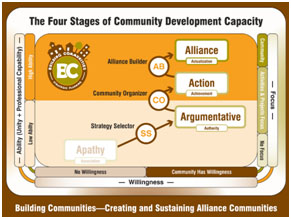 Still other communities did not seem to even care at all. I couldn’t ignore those communities, so we just had lunch once per month and called it good. They were happy. I was confused. How could communities behave this way? Don’t they want to roll up their sleeves and get fun things done? Don’t they want to become better places? Don’t they want to create jobs?
I expected to find communities with differing assets – something I would soon describe as Key Success Factors. I expected communities to select different groupings of projects – something I would later describe as one of 25 Strategies. I would expect that each community was completing different activities to reach their goals – something I would later refer to as Example Action Steps and Suggested Possible Tasks. But I never expected to discover the difference in the soul of each community – something I would later describe as civic condition.
 During this era the State of Oregon created something called the Oregon Progress Board. It was a strategic thinktank that created Oregon Shines. This was a strategic vision/plan for the future of the state. In 1999, the Progress Board was writing their annual report. My phone rang. Brian, your community, Baker City, represents all that is good about civic advancement. We would like to feature your community on the cover page of our report. I knew exactly what to do. I called my 40 best friends. The Progress Board rented a helicopter. We all stood on that prominent location at the National Historic Oregon Trail Interpretive Center at Flagstaff Hill looking up at that helicopter. There was the photographer. That was the picture. 40 people all looking up in the same direction. Standing atop one of the greatest achievements in county history. United. Hopeful. Together.
During that same year, the two largest general foundations in Oregon reserved rental vans and hauled their board of directors hundreds of miles to explore what was going on in Baker City. Both foundations made gigantic grant awards to the Baker Community Partnership, an unofficial collection of volunteers collaborating on a portfolio of 10 top community and economic development projects.
Baker City/Baker County was unstoppable.
I Just had to Run for Something
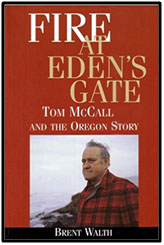 It was the summer of 1998 and I was doing something I had rarely done. I was reading a book. Fire at Eden’s Gate: Tom McCall and the Oregon Story. One of the most colorful political characters in the entire Western United States in the 1960s was Tom McCall. With his six-foot-five-inch frame and Boston accent, he was legendary. For me, those attributes, combined with his ingenuity and courage, led me to read that book. And then I read a passage related to his pre-political era when he thought I just have to run for something. He ran for Governor and won. And won.
That was the first time I thought about it myself. Running for political office. I was enjoying my time working in five counties. And yet the fulfillment of focusing on one county and once again being integral to the local winning team was paramount. That would not be Governor. That would not be Congressmen. It had to be a local office. There was only one job that fit: county commission chairman.
By the time I put my name in the hat my good friend Larry, the mayor, did the same thing. Everybody liked Larry. He was a good guy. He had a big heart. He would do anything to help his community. And there was another lady that I did not know, but I knew she was respected within the Mormon Church. And the Mormon Church was a big deal in my community. I had my hands full. For me, it was not about beating them. Far from it. I wanted to work with them. I remember creating that little tri-fold pamphlet which was my only political message. What is your vision for Baker County? Mine is… if you agree, vote for me. That was it. That was the only message. I won 69%-17%-14%. I was elated. But I was heartbroken thinking about how it impacted my good friend Larry.
 My first day in office was January 1, 1999. The honeymoon lasted 15 months. I remember where I was on Y2K. It was midnight. I was awake. Would the computers all go haywire? Was life as we know it changed forever?
I believe that Y2K went off in our heads, not our computers. At least that is how I explain it. I was still the same guy. We were still doing the same things. I still had the same friends. The same people were on the same committees. But by April of 2000 I did not recognize my own county. It was no longer about rolling up our sleeves and getting things done. It was about forming a circular firing squad and shooting as fast as we could. What happened to my little community? And why is everybody shooting at me?
In today’s environment, it is easily explained: You are an elected official and therefore you are a target. But really? Was it always that way before? Did it have to be that way every day since? Once again: civic condition. I was learning that the only way to get things done was to do it quietly and then when it was safely in place we could talk about it. What a different world than 40 people looking up at a helicopter on Flagstaff Hill only months earlier.
Hanging out a Shingle
By January 1, 2003, I had done it all. I had the best job in the world. I had the worst job in the world. I had succeeded. I had failed (the 1998 ratio of 69%-17%-14% shrunk to 49%-51%). And maybe I had some inkling that I was married to the real hero of Baker County. By then, her blood was running purple and gold. Earlier that fall she took seven future librarians and assembled them on a cross country team and won the state championship. There was nothing she could do wrong. The entire community loved her. And that trajectory has grown every day since. The hero of Baker County had actually been married to the hero of Baker County all along. The same young newlywed that advised her husband to pursue his career in her competing town of Baker was fully entrenched in a successful career of her own. It was time for me to do something different. Only this time, unlike the Big Eight accounting firm opportunity of 1987, I really did have something to offer. It was time to make it work in the private sector.
Packing the Toolbox
 When I think back to my early years, I realize I must have been wired to think about the same thing over and over again for a period of years. I attribute my perseverance to one of my greatest weaknesses. I do not seem to remember much of anything that is not a profound event. So, when I go back and look at the tools, theories, and practices of economic development strategic planning that I have invented, I do not remember much of it. Other than the events. There was the time when Suzy was a volunteer volleyball coach that I wrote down all of the Key Success Factors. There was the time by the pool in Klamath Falls that I wrote the first edition of the Civic Condition Assessment (which I then called the Community Motivation Personality Test). There was the day in my driveway where I walked and dictated the entirety of the original Community Organizer Assessment.
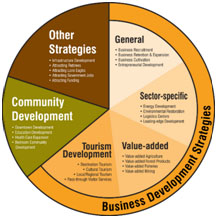 In 2010, I wrote a book: 25 Strategies to Advance America. In that book’s epilogue I wrote: I view the publishing of this book as only the first step in the transformation of economic development strategic planning in America. My vision is to establish complementary software that will enable economic development professionals to conduct their own Building Communities-based strategic plan. States may wish to engage Building Communities to create greater rigor for existing or prospective statewide certified cities programs. A Building Communities Institute may be formed to train and certify economic development consultants to utilize this approach to augment their business and enhance their capabilities.
By 2015, it was time to write a second book. This one would polish many of the thoughts and ideas from 2010. In it, I would compare economic development strategic planning to the biomimicry of a tree. The elements of this work can be explained by thinking about the soil, the trunk, the leaves, etc. It can also be compared to the completeness and function of the human body. In other words, the title of the second book Why Some Communities Succeed, Why Some Fail and What to do About it is based upon a holistic understanding of what it takes to achieve the two ultimate goals of community and economic development: improved economic condition and enhanced quality of life.
A lifetime worth of professional economic development experiences have combined to offer this unique lens on What to do About it. To ignore any of these lessons is tantamount to the failure of communities to successfully envision and enact their future.
Beginning by DASHing
 Barack Obama became the 44th President of the United States in 2009. Other than a brief stint as a U.S. Senator, his primary job description up to that point was that of a community organizer. One of the signature efforts of the Obama Administration was the Partnership for Sustainable Communities. He wanted to organize three of the federal agencies (Housing and Urban Development (HUD), Department of Transportation (DOT), Environmental Protection Agency (EPA)) to be responsive to regions throughout the United States to create regional sustainability plans. HUD issued a notice of funding availability for regions to be formed and grant proposals to be submitted.
 The Partnership for Sustainable Communities initiative was exactly what was needed to galvanize all the theories and tools into fully functioning economic development strategic planning software. The smartest computer guy in my life was Kevin Bradford, so I walked down the hall and discussed how he could help if a grant application I was developing for Apache County Arizona would be successful. If it were, we would have to complete 12 economic development strategic plans in a matter of months. Kevin was familiar with a software program called FileMaker Pro, and he could engineer software utilizing that program to meet the needs – as long as someone from the Building Communities team was on-site to facilitate the process. Kevin would name the software DASH™. Not only was the grant to Apache County approved, but the following year similar and larger awards were made in Western North Dakota and Northeastern Arkansas. Building Communities was on its way to becoming one of the most active economic development strategic planning companies in the nation. Today, the methodology has now been used in nearly 100 communities from coast to coast.
The methodology and software were working very well. Every strategic plan was completed on time. Hundreds of satisfaction surveys were completed concluding that people were highly satisfied with the strategic planning process. As with all grant-funded projects, the project period would have to come to an end. The plans would be completed. Local steering committees would still exist. But there was no guarantee that plan implementation would occur, jobs would be created, and communities would be improved. And even if such progress occurred, it was challenging for Building Communities to keep tabs on it.
Planning and Tracking the Action
By 2015 it was clear that the biggest challenge was plan implementation. Primarily working in rural communities, most cities and counties did not have local economic development professionals that could lead the implementation of their plans.
We began with paper surveys that would allow planning participants to figure out “who would do what by when.” The paper surveys didn’t work. We then advanced to fillable PDFs. Those didn’t work either. We tried other forms of rudimentary software, but there was still no way to help guide the implementation phase and to assist communities to track and report such progress.
 By this time, we had 186 Example Action Steps (EASs) and nearly 1000 Suggested Possible Tasks (SPTs). Planning participants could utilize the EASs and SPTs, or simply reflect upon them and be inspired to create their own action steps. But even this proved that we needed to create an electronic system whereby these planning tools could be furnished at the right time and the right place for busy volunteers.
A Fellow Bilagáana
 If economic development strategic planning is my first professional love, then Navajo is my second. While attending the annual Navajo Economic Development Summit in 2018 against the backdrop of the San Francisco Peaks, I stepped outside to catch a breath of fresh air. I was surrounded by 300 of my Navajo friends… and one bilagáana – what the Navajo refer to as white people. What brings you here he asked. I replied I’m here to apply my economic development passion to help improve the lives of the Navajo people. What do you do? The bilagáana replied: I work with a program that you have never heard of before. It is called the SBIR Program. I knew that he was referring to the Small Business Innovation Research program – a program that provides grant funding to private sector companies that may have research and development interests aligned with the priorities of various federal agencies. One thing led to another, and Building Communities won a $100,000 grant through the SBIR program to create an online Action Planner Tracker (APT) tool. One year later Building Communities had the ability to work with communities to guide them to consider all of the EASs and SPTs utilizing software that would also help them communicate their progress to their community. The biggest bottleneck to economic development strategic plan implementation had been solved.
From a DASH to a SPRINT
If Obama’s Partnership for Sustainable Communities initiative took Building Communities to the pace of a DASH, then the pandemic took us to the pace of a SPRINT.
 When most people think of the Coronavirus, they think of the heath consequences to humanity. But, undeniably, COVID-19 had a dramatic impact to the U.S. and world economy. Within a couple of months, the entire manner in how business and government functioned was transformed. People were not working from their offices, they were teleworking from their homes. And within a year we were talking about the Great Resignation, a wholesale shift in how people think of working and why they should even work at all.
The federal government responded with multiple large-budget programs including the CARES Act. Included within the CARES Act was funding for the Economic Development Administration (EDA) which resulted in the Scaling Pandemic Resilience Through Innovation and Technology (SPRINT) program. One of the objectives of the SPRINT program was to develop and scale an innovative entrepreneurship support model to address the virtual and remote work environment of the pandemic.
What a perfect opportunity! During the grant writing phase for the successful SBIR grant, we were required to forecast the benefit to Building Communities by fully exploiting the software to be created with the grant funding. We determined: 1) the upside was substantial, and 2) our greatest market was the EDA network that developed Comprehensive Economic Development Strategies (CEDS) for over 300 regions and Tribes throughout the United States. Where the SBIR program funded the Action Planner Tracker, the SPRINT program could assist with the other seven economic development strategic planning tools to digitize them and to make their use available virtually. Building Communities engaged with a non-profit corporation to successfully apply for the funding and to continue engaging the same software engineer to focus upon the other tools.
What a time to be in the rural economic development strategic planning business with virtual tools that address the new workplace dynamics caused by the pandemic.
False Start on the SPRINT
While the EDA SPRINT grant held great promise to create software that local economic developers and civic activists could utilize to envision and enact their community’s future, the execution of that grant failed. The 18 months spent to develop and test this software on the Navajo Nation, Hopi Tribe, and other communities in Northern Arizona never produced a single plan, never mind the basis for software that could be deployed anywhere.
It might be, however, that there was an emerging, world-changing technology that was going to make the decentralized decision-making implications of the pandemic negligible compared to what lie in store. It might have been that even if the SPRINT project was a success, that software would have been rendered meaningless. The era of AI was about to emerge.
2025: Eight Random Occurrences that made the 2010 Prediction Prescient
In 2022 I forecasted that I would have a “major collapse” in 2024. This was based upon life-changing, major events in 2010, 1996, 1982, and at the precious age of five in 1967. There was something in my mind about a “roughly 14-year cycle” that felt like a ticking time bomb that would explode sometime in 2024.
Boom! Right on time, my catastrophic event happened on February 9 when I learned that Navajo Nation President Buu Nygren was terminating the contract that Building Communities was doing to develop a Manufactured Housing Plan for Nahata Dziil. Although my 14th year collapse was in full effect, I had a sense that Year 1 (2025) held tremendous progress.
By December 2025, I could look back on the year and see eight occurrences that portended a new and exhilarating direction for Building Communities.
First, on a long layover in Salt Lake City, I scheduled myself to sit down with a dear international humanitarian friend, Chris Johnson. Whereas I had a lens on the developing world of Navajo and Hopi, he had a much bigger lens on the developing world of the globe.
Second, during that long layover, Chris introduced me to Ben Callis. Ben was a software engineer, and during our second in-person meeting later in April I looked over his shoulder at his laptop and he was scrolling through every word I had ever written! Not only did he apparently find access to all of these materials, but he seemed to read at a 500 words per second pace.
Third, Ben introduced me to Babe Kilgore. With Babe, I met a superb businessman with a heart that matched that of Chris and myself in seeking ways to make large-scale benefit to the people in this world that need it the most. He was looking for inroads to Hopi, and I was discovering his business and sales acumen that had heretofore been missing in my practice.
Fourth, Babe introduced me to James Chism. With James, I began to realize that the geographic scope for the Building Communities Strategic Planning Methodology should be far greater than the United States alone.
Fifth, James introduced me to Derrick Clyburn Ballard. With Derrick, I met a gentleman that had acquired global satellite technology which could inform my Key Success Factors with broad and deep (below-the-surface-of-the-earth-deep!) data that could fortify the Key Success Factor Analysis (KSFA).
Sixth, Dan Suhr reappeared in my life and notified me of a unique deadline for Building Communities to reapply for an SBIR Phase II award. Our odds would be quite high to receive the grant, and this would enable us to integrate AI into the KSFA, Civic Condition Assessment (now the Community Sentiment Analysis), and the Community Organizer Assessment (now the Civic Capacity Assessment).
Seventh, Arsh Haque would approach me out of the blue as he was developing his own software platform to connect previous SBIR awardees such as Building Communities to venture capital. Given all of the new connections and technology prospects, I began investigating a worldwide market.
Finally, eighth, Harvard Growth Lab would review my Hopi CEDS and marvel as to how an apparently non-native consulting firm could produce such a comprehensive document spoken through the voice of the Hopi people themselves.
In short, while not reaching out to any of these prospects and developments, they all fell in my lap. Year 1. The only questions as the calendar was about to turn to Year 2 were…How far? How fast?